

Learning stock market trading in India can feel overwhelming at first.
A simple online search returns thousands of videos, articles, indicators, strategies, opinions, and bold market predictions. Social media is filled with profit screenshots, trading influencers, and confident voices claiming certainty.
For a beginner, the amount of information often creates more confusion than clarity.
That confusion is not a personal failure. It is the natural outcome of an environment where visibility is frequently rewarded more than accuracy, and excitement often attracts more attention than education.
Professional market participation does not begin with tips, shortcuts, or secret strategies.
It begins with understanding.
Financial markets are not designed to distribute quick wealth. They are structured systems where capital is allocated, prices are discovered, and risk is continuously transferred between participants. Over time, markets tend to reward disciplined decision-making while exposing emotional and impulsive behaviour.
If you want to learn stock market trading in India properly—whether your long-term goal is investing, swing trading, or active trading—the first priority should not be finding the “best strategy”. It should be building a strong foundation.
That is exactly what this guide is designed to help you do.
Rather than overwhelming you with isolated concepts, this guide follows a structured learning journey that develops understanding step by step. You will progress from the fundamentals of how Indian financial markets operate to the practical principles that shape disciplined market participation.
By the end of this guide, you will understand:
- How the Indian stock market works
- The different financial instruments available for trading and investing
- The foundations of technical and fundamental analysis
- Why risk management matters more than prediction
- How trading psychology influences decision-making
- A practical 90-day roadmap for beginners
- The most common mistakes new traders make—and how to avoid them
- How to develop your own market philosophy
- How to choose a broker and trading platform
- How to continue learning independently after completing this guide
This is not a guide that promises quick profits, guaranteed returns, or effortless success.
Financial markets simply do not work that way.
Instead, this guide offers something far more valuable: a structured framework for learning, thinking, and participating responsibly.
Over many years of observing financial markets, one lesson consistently stands out:
Discipline compounds. Impulsiveness compounds too—but in the opposite direction.
If you are willing to learn patiently, think objectively, and build your knowledge one step at a time, this guide will provide a reliable starting point.
Before placing your first trade—or investing your first rupee—you should first understand the environment you are entering.
Let’s begin by understanding why so many beginners struggle before they even get started.
Table of Contents
- Why Most Beginners Fail Before They Start
- What You Must Understand Before Trading
- What Can You Trade in the Indian Stock Market?
- How Professionals Interpret the Markets
- Risk Management — The Skill That Keeps You in the Market
- Trading Psychology — Why Your Mind Matters More Than Your Market Knowledge
- Understanding the Psychology Behind Market Decisions
- Common Cognitive Biases That Affect Traders
- Process Versus Outcome — The Professional Mindset
- Building Discipline Through Systems
- Why Keeping a Trading Journal Matters
- Managing Losses Without Losing Control
- Emotional Consistency Is a Competitive Advantage
- Reading Financial News Without Getting Distracted
- Your First 90 Days in the Stock Market — A Structured Learning Plan
- Common Stock Market Mistakes Beginners Should Avoid
- Developing Your Own Market Philosophy
- What Is a Market Philosophy?
- Accepting That Markets Are Probabilistic
- Capital Preservation Comes Before Capital Growth
- Understanding Whether You Are an Investor or a Trader
- Finding a Style That Matches Your Personality
- Questions Every Beginner Should Answer
- Your Philosophy Will Continue to Evolve
- Build Principles Before Building Strategies
- Choosing the Right Broker and Trading Platform
- What Does a Stockbroker Do?
- Understanding the Different Types of Brokers
- Factors to Consider Before Opening an Account
- Understanding Trading and Demat Accounts
- Should Beginners Use a Demo or Paper Trading Platform?
- Technology Supports Decisions—It Does Not Replace Them
- Choose for the Long Term, Not for Marketing
- Resources to Continue Your Stock Market Learning
- Books Every Beginner Should Consider Reading
- Learn from Reliable Sources
- Use Market Data to Improve Understanding
- Choose Communities That Encourage Learning
- Build a Habit of Keeping a Learning Journal
- Review Your Progress Regularly
- Build Your Own Learning System
- Lifelong Learning Is One of the Greatest Market Advantages
- Where to Go from Here
- Conclusion — Build Knowledge First, Results Later
- Frequently Asked Questions - (FAQs)
- Disclaimer
What You Will Learn
By the end of this guide, you will be able to:
- Understand how the Indian stock market functions and the role of key market participants.
- Differentiate between investing, trading, speculation, and the major financial instruments available in India.
- Build a foundation in technical analysis, fundamental analysis, risk management, and trading psychology.
- Recognise common beginner mistakes and develop habits that support disciplined decision-making.
- Follow a structured learning path that prepares you for long-term market participation rather than short-term excitement.
Why Most Beginners Fail Before They Start
Every year, thousands of people across India open trading and demat accounts with genuine curiosity and the intention to learn. They watch YouTube videos, read blogs, follow financial influencers, join Telegram and WhatsApp groups, and consume an endless stream of market content.
Yet after a few months, many find themselves confused, frustrated, or with significantly less capital than when they began.
The problem is rarely a lack of effort.
More often, it is the absence of a structured learning process.
Information about the stock market has never been more accessible. Structured financial market education, however, remains comparatively rare.
Many beginners are introduced to intraday trading, options strategies, leverage, indicators, and chart patterns long before they understand how financial markets function, why prices move, or how risk should be managed.
Without strong foundations, learning becomes reactive rather than deliberate.
Confidence begins to depend on recent outcomes rather than on understanding. A small profit creates overconfidence. A small loss creates doubt. News headlines replace analysis. Social media replaces independent thinking. Gradually, learning becomes fragmented, and so do results.
Successful market participation rarely begins with finding the perfect strategy.
It begins with developing the right framework for understanding markets.
This guide has a single objective:
To provide Indian beginners with a structured foundation for learning stock market trading—so that knowledge develops through understanding rather than through trial and error.
Instead of starting with trading tactics, we will begin with principles.
Once those principles become clear, every concept that follows—market instruments, analysis, risk management, psychology, and execution—becomes easier to understand within the right context.
Before learning how to trade, it is essential to understand what you are participating in and why financial markets behave the way they do.
That foundation begins next.
What You Must Understand Before Trading

Before opening a trading account, studying charts, or placing your first trade, it is worth taking a step back.
The Indian stock market is far more than a place where buyers and sellers exchange shares. It is a structured financial system shaped by regulation, institutional participation, liquidity, corporate performance, economic conditions, and continuous price discovery.
Many beginners enter the markets with urgency.
Professionals enter with context.
That distinction often marks the beginning of disciplined market participation.
What Is the Stock Market? (And What It Is Not)
At its core, the stock market exists to facilitate the efficient allocation of capital and the continuous discovery of prices.
Companies raise capital to expand operations, invest in innovation, strengthen their balance sheets, or finance future growth. Investors provide that capital in exchange for ownership. Traders contribute liquidity by continuously buying and selling securities, helping prices adjust as new information becomes available.
Price is not a promise.
It is the market’s collective assessment of value under conditions of uncertainty.
Markets exist because uncertainty exists.
Every change in earnings expectations, interest rates, government policy, industry developments, geopolitical events, or investor sentiment influences how participants value businesses and financial assets. As expectations change, prices adjust accordingly.
Volatility is therefore not evidence of chaos.
It is evidence that markets are continuously repricing risk.
Professional participants understand that uncertainty cannot be removed. It can only be understood and managed.
The stock market is not designed to distribute quick profits equally among participants. It is a competitive environment where disciplined decision-making generally produces better long-term outcomes than emotional reactions.
Many beginners mistake constant activity for meaningful progress.
Experience gradually teaches the difference.
Investing, Trading, and Speculation — Understanding the Difference
The terms investing, trading, and speculation are often used interchangeably, but they represent fundamentally different approaches to participating in financial markets.
Investing
Investing focuses on long-term ownership of businesses.
Capital is allocated with the expectation that a company’s earnings, competitive position, and intrinsic value will grow over time. Investors generally measure success across years rather than days or weeks.
Trading
Trading focuses primarily on price movement over shorter time horizons.
Rather than concentrating solely on business valuation, traders evaluate probability, market structure, timing, and risk management. Success depends less on predicting the future and more on consistently managing uncertainty.
Speculation
Speculation relies primarily on expectation, momentum, narratives, or hope, often without a structured framework for evaluating probability or managing risk.
Although speculation exists in every financial market, sustainable participation usually requires moving beyond speculation towards disciplined decision-making.
The distinction ultimately lies in intention.
A long-term investor may tolerate significant short-term volatility because the investment thesis is based on business fundamentals.
A trader cannot ignore risk management because price movement itself determines the outcome.
Speculation frequently allows emotion to replace structure.
Understanding these differences helps beginners choose an approach that matches both their objectives and temperament.
Why Activity Is Not the Same as Progress
One of the most common misconceptions among beginners is that frequent trading accelerates learning.
It rarely does.
Watching prices continuously, placing numerous trades each day, or constantly switching between strategies may feel productive, but excessive activity often increases transaction costs, emotional fatigue, and inconsistent decision-making.
Markets reward clarity.
They do not reward constant motion.
Experienced participants recognise that choosing not to trade can sometimes represent the highest-quality decision available.
Remaining patient while waiting for favourable conditions demonstrates discipline rather than hesitation.
Trading is not a test of activity.
It is a test of decision quality under uncertainty.
The sooner beginners understand this principle, the stronger their foundation becomes.
Understanding the Indian Market Ecosystem
For many beginners, the Indian financial market initially appears complex.
Terms such as SEBI, NSE, BSE, NSDL, CDSL, clearing corporations, brokers, and depositories are frequently mentioned, yet their individual roles are often unclear.
In reality, the system follows a clearly defined structure.
Securities and Exchange Board of India (SEBI)
The Securities and Exchange Board of India (SEBI) is the primary regulator of India’s securities market.
SEBI establishes regulations, supervises market participants, promotes transparency, and seeks to protect investors while maintaining orderly market functioning.
Regulation builds confidence.
Without trust, capital markets cannot function efficiently.
National Stock Exchange (NSE) and Bombay Stock Exchange (BSE)
The NSE and BSE provide the electronic marketplaces where buyers and sellers interact.
When an investor or trader places an order through a registered broker, that order is transmitted to the exchange, where matching occurs according to price and time priority.
The exchange facilitates price discovery.
It does not participate in directional trading.
Clearing Corporations
After a trade is executed, the clearing corporation manages settlement obligations between buyers and sellers.
This process significantly reduces counterparty risk and strengthens confidence in the financial system.
Settlement is not merely an administrative process.
It is a critical component of market integrity.
Depositories (NSDL and CDSL)
Depositories maintain securities in electronic (dematerialised) form.
Whenever shares are bought or sold, ownership records are updated electronically through the depository system.
Stock Brokers
Registered brokers provide market access through trading platforms, order execution systems, account reporting, and related services.
While brokers facilitate participation, they do not influence market direction or guarantee trading outcomes.
Understanding the role of each participant transforms the market from something that appears confusing into a structured financial ecosystem where every institution performs a specific function.
Knowledge reduces uncertainty.
The Three Principles That Remain Constant
Markets, strategies, and instruments continue to evolve.
Three principles remain remarkably consistent across every market environment.
1. Risk Comes First
Every financial market involves uncertainty.
Uncertainty creates the possibility of loss.
Experienced traders do not attempt to eliminate losses. They focus on defining and controlling them.
Risk management always precedes return.
Ignoring risk does not remove it.
It merely postpones its consequences.
2. Behaviour Shapes Results
Markets constantly test emotional discipline.
Fear encourages premature exits.
Greed encourages excessive risk-taking.
Overconfidence often follows winning streaks.
Frustration frequently leads to impulsive decisions after losses.
Behavioural finance demonstrates that cognitive biases influence decision-making even among highly intelligent individuals.
Professionals therefore devote as much attention to managing themselves as they do to analysing markets.
3. Structure Creates Consistency
Discipline is rarely the result of motivation alone.
It develops through predefined processes.
Clear entry criteria, position sizing rules, exit plans, risk limits, journaling, and regular performance reviews transform emotional reactions into measurable behaviour.
Consistency does not guarantee profitable outcomes.
It creates a framework through which improvement becomes possible.
When risk receives respect, behaviour receives attention, and structure guides decision-making, financial markets become significantly easier to understand.
They remain uncertain.
But uncertainty becomes manageable rather than overwhelming.
These three principles form the foundation for everything discussed throughout the remainder of this guide.
With that foundation established, the next step is understanding the different financial instruments available in the Indian market—and how each differs in purpose, structure, and risk.
What Can You Trade in the Indian Stock Market?

Once you understand the foundations of risk, behaviour, and market structure, the next logical question is:
What exactly can you trade or invest in within the Indian financial markets?
Many beginners assume that the stock market is simply a place to buy and sell company shares.
In reality, India’s financial markets offer a wide range of financial instruments, each designed for different objectives, levels of risk, capital requirements, and participant profiles.
Understanding these instruments is essential because the instrument you choose directly influences the type of decisions you will make, the risks you will face, and the knowledge you need before participating.
Professional market participants do not begin with the most complex products. They first understand what each instrument is designed to achieve. Understanding why different asset classes matter helps build a broader market perspective before specialising in any one area.
Broadly, the Indian financial markets include:
- Equity Shares
- Market Indices
- Mutual Funds
- Exchange Traded Funds (ETFs)
- Futures
- Options
- Commodities
- Currencies
Each serves a different purpose within the broader financial ecosystem.
Equity Shares — Becoming a Part Owner of a Business
Equity shares represent ownership in a listed company.
When you purchase shares of a company listed on the National Stock Exchange (NSE) or Bombay Stock Exchange (BSE), you become a shareholder and acquire a small ownership interest in that business.
Shareholders may benefit if the business grows successfully over time. Depending on the company’s policies, they may also receive dividends or gain voting rights on certain corporate matters.
However, ownership also means sharing business risk.
If a company’s earnings weaken, competition intensifies, regulations change, or economic conditions deteriorate, its market value may decline.
Share prices therefore reflect much more than historical performance.
They reflect how market participants collectively assess the company’s future prospects.
In India, listed companies are commonly grouped according to market capitalisation.
Large-Cap Companies
Large-cap companies are well-established businesses with significant market value, broad institutional ownership, and relatively high liquidity.
Although they remain exposed to market risk, they often exhibit comparatively lower volatility than smaller companies.
Mid-Cap Companies
Mid-cap companies typically offer greater growth potential than large-cap businesses but often experience higher price volatility as their business models continue to evolve.
Small-Cap Companies
Small-cap companies generally have lower market capitalisation and may operate in specialised or emerging industries.
Their shares often experience larger price fluctuations due to lower liquidity, limited institutional participation, and higher sensitivity to market sentiment.
Higher volatility should never be confused with higher certainty of returns.
Volatility simply reflects greater variation in price movement.
For most beginners, equity investing provides the most intuitive starting point because the concept of business ownership is relatively straightforward and does not initially require understanding leverage or derivative pricing.
Market Indices — Measuring Overall Market Performance
Rather than tracking a single company, market indices measure the performance of a selected group of companies.
India has several widely followed indices, including:
- Nifty 50
- Sensex
- Nifty Bank (Bank Nifty)
- Nifty Next 50
- Sector-specific indices
An index is not a company.
It is a mathematical representation of the collective performance of its constituent stocks.
For example, the Nifty 50 reflects the performance of fifty of India’s largest and most actively traded companies across multiple sectors.
Market indices help participants understand the broader direction of the market rather than focusing exclusively on individual stocks.
A stock may rise while the overall market declines.
Similarly, the overall market may advance even though certain sectors underperform.
Studying indices helps beginners understand market breadth, sector rotation, institutional participation, and overall investor sentiment.
They provide context that individual stocks cannot.
Mutual Funds and Exchange Traded Funds (ETFs)
Not every market participant wants to select individual stocks or trade actively.
Many prefer diversified investment vehicles managed through structured portfolios.
Mutual Funds
Mutual funds pool money from multiple investors and allocate it across various securities according to a defined investment objective.
Some funds are actively managed by professional fund managers who seek to outperform a benchmark.
Others follow passive investment strategies that simply aim to replicate an index.
Each approach involves different trade-offs regarding cost, management style, and expected outcomes.
Exchange Traded Funds (ETFs)
ETFs also provide diversified exposure but trade on stock exchanges throughout the trading day, much like ordinary shares.
They combine many of the diversification benefits of mutual funds with the flexibility and transparency of exchange trading.
For beginners, both mutual funds and ETFs demonstrate that financial market participation extends well beyond active trading.
Many experienced market participants maintain separate portfolios for long-term investing while managing trading activities independently.
Different objectives often require different approaches.
Futures and Options — Understanding Derivative Markets
Derivatives derive their value from another financial asset, known as the underlying asset.
The underlying may be:
- An equity share
- A stock market index
- A commodity
- A currency
Unlike equity shares, derivatives do not represent ownership.
They are financial contracts based on the price movement of another asset.
Futures Contracts
A futures contract creates an obligation between buyers and sellers to transact at a predetermined price on a specified future date, unless the position is closed earlier.
Options Contracts
An options contract provides the buyer with the right, but not the obligation, to buy or sell the underlying asset at a predetermined price before expiry.
The seller of the option assumes the corresponding contractual obligation.
This distinction between rights and obligations is fundamental to understanding options.
Because derivatives frequently involve leverage, relatively small price movements can produce disproportionately larger gains or losses.
Leverage magnifies opportunity.
It also magnifies risk.
For this reason, beginners should first understand derivative markets conceptually before considering active participation.
Knowledge should always precede complexity.
Commodities and Currency Markets
Indian financial markets also include commodities and currencies, each influenced by different economic drivers than corporate equities.
Commodities
Commodity markets include assets such as:
- Gold
- Silver
- Crude Oil
- Natural Gas
- Agricultural commodities
Commodity prices are influenced by global supply and demand, geopolitical developments, weather conditions, production levels, and international economic activity.
Currency Markets
Currency markets involve trading currency pairs such as USD/INR.
Exchange rates respond to factors including:
- Interest rates
- Inflation
- Monetary policy
- Trade balances
- Capital flows
- Global macroeconomic developments
Participants in commodity and currency markets often include exporters, importers, institutional investors, hedgers, and experienced traders seeking to manage specific forms of financial risk.
These markets demonstrate that financial systems operate within an interconnected global economy. Understanding how different markets influence each other helps explain why experienced traders rarely analyse any single market in complete isolation.
Corporate earnings are only one part of a much larger picture.
Choosing the Right Starting Point
Every financial instrument serves a different purpose.
- Equity shares introduce business ownership.
- Market indices provide insight into overall market direction.
- Mutual funds and ETFs offer diversified participation.
- Futures and options introduce leverage and contractual risk.
- Commodities and currencies expand understanding beyond corporate performance into the broader global economy.
Professionals rarely begin by pursuing the most complex instrument available.
Instead, they build knowledge progressively.
As understanding grows, so does the ability to evaluate whether a particular instrument aligns with individual objectives, available time, risk tolerance, and learning stage.
Understanding what you can trade is only one part of becoming a knowledgeable market participant.
The next step is learning how professionals interpret market information—through technical analysis, fundamental analysis, and a structured understanding of price behaviour.
How Professionals Interpret the Markets
Every trading day, financial markets generate an enormous amount of information.
Prices fluctuate continuously. Volumes expand and contract. Companies release earnings. Governments announce policies. Central banks adjust interest rates. Global events influence investor sentiment within seconds.
To a beginner, this constant flow of information often appears overwhelming.
Professionals approach it differently. Rather than reacting to every headline or price movement, they rely on structured analytical frameworks that help them interpret market behaviour objectively. Readers who want to explore how professional traders think across asset classes can continue with that discussion before diving deeper into the analytical frameworks introduced below.
Broadly, experienced market participants analyse markets through two complementary lenses:
- Technical Analysis
- Fundamental Analysis
These approaches are often presented as competing schools of thought.
In reality, they answer different questions.
Technical analysis studies how the market is behaving.
Fundamental analysis examines why an asset may have value over time.
Neither approach removes uncertainty.
Both aim to improve decision-making.
Technical Analysis — Understanding Price Behaviour
Technical analysis is built on a straightforward principle:
Market prices reflect the collective actions and expectations of all participants.
Every completed trade represents a decision made under uncertainty. When thousands of these decisions are combined, they produce observable patterns in price and trading activity.
Price becomes a record of behaviour.
Price and Volume
Technical analysts primarily study two variables:
- Price
- Volume
Price shows where transactions occur.
Volume indicates the level of participation behind those transactions.
When prices rise alongside increasing volume, it may suggest broader market participation.
When prices rise while volume declines, conviction behind the move may be weaker.
Volume adds context to price movement rather than predicting future direction.
Trends
Markets rarely move in perfectly straight lines.
Instead, they develop trends.
An uptrend generally consists of higher highs and higher lows.
A downtrend generally consists of lower highs and lower lows.
A sideways market reflects a period during which neither buyers nor sellers maintain sustained control.
Understanding trend helps participants recognise prevailing market conditions rather than attempting to predict every future movement.
Support and Resistance
Support and resistance represent areas where market participants have previously shown significant buying or selling interest.
- Support is an area where buying demand has historically exceeded selling pressure.
- Resistance is an area where selling pressure has previously exceeded buying demand.
These are not fixed price points.
They are zones where participants reassess previous decisions.
Because market participants remember important price levels, these areas often become focal points for future activity.
Technical Indicators
Technical indicators are mathematical calculations derived from historical market data.
Common examples include:
- Moving Averages
- Relative Strength Index (RSI)
- MACD
- Bollinger Bands
- Average True Range (ATR)
Indicators do not predict the future.
They organise historical information into formats that may assist analysis.
Experienced traders understand that indicators complement price analysis.
They do not replace judgement.
Adding numerous indicators to a chart rarely improves clarity.
It often creates unnecessary complexity.
Asking Better Questions
Rather than searching for certainty, technical analysis encourages participants to ask structured questions such as:
- What is the prevailing market trend?
- Is momentum strengthening or weakening?
- Where have buyers or sellers previously become active?
- Is market participation expanding or contracting?
- Does current price behaviour support the broader market structure?
These questions improve observation.
They do not guarantee outcomes.
Technical analysis is best viewed as a framework for interpreting market behaviour rather than predicting future prices.
Fundamental Analysis — Understanding Business Value
While technical analysis studies market behaviour, fundamental analysis studies the economic characteristics of the underlying business or asset.
Its central objective is to understand the factors that may influence long-term value.
Rather than focusing primarily on price movement, fundamental analysis examines questions such as:
- How does the company generate revenue?
- Is the business profitable?
- Does it have sustainable competitive advantages?
- How effectively does management allocate capital?
- How healthy is its financial position?
Fundamental analysis seeks to understand the business behind the share price.
Financial Statements
Most fundamental analysis begins with three primary financial statements.
H5: Profit and Loss Statement (Income Statement)
This statement summarises:
- Revenue
- Expenses
- Operating profit
- Net profit
It helps evaluate how effectively a company converts sales into earnings.
Balance Sheet
The balance sheet presents the company’s assets, liabilities, and shareholders’ equity at a specific point in time.
It provides insight into financial strength and capital structure.
Cash Flow Statement
Cash flow analysis examines how money moves through the business.
A profitable company does not always generate strong cash flow.
Understanding this distinction provides a more complete picture of financial health.
Financial Ratios
Fundamental analysts frequently use financial ratios to compare businesses more effectively.
Common examples include:
- Price-to-Earnings (P/E) Ratio
- Price-to-Book (P/B) Ratio
- Return on Equity (RoE)
- Debt-to-Equity Ratio
- Earnings Per Share (EPS)
These ratios should never be interpreted in isolation.
Their significance depends on industry characteristics, economic conditions, and the company’s broader business model.
Price Versus Value
One of the most important ideas in fundamental analysis is understanding the distinction between price and value.
Price reflects what market participants are currently willing to pay.
Value reflects the underlying economics of the business.
The two are not always identical.
In the short term, market sentiment often dominates.
Over longer periods, business performance generally exerts greater influence.
Fundamental analysis therefore provides a framework for understanding why prices may eventually change, even when current market sentiment differs.
Understanding Derivative Markets as a Source of Information
Derivative markets provide more than trading opportunities.
They also offer insight into how market participants are positioning themselves.
Professionals often monitor derivatives to better understand market expectations and risk distribution.
Futures Markets
Futures prices reflect expectations regarding future pricing, financing costs, liquidity, and market sentiment.
Changes in futures positioning may indicate shifts in institutional participation or broader market confidence.
Options Markets
Options introduce additional information through concepts such as:
- Implied Volatility (IV)
- Open Interest (OI)
- Option Premiums
- Time Decay
Although these concepts require deeper study, they provide valuable insight into how participants are managing risk or expressing market expectations.
Importantly, none of these measures predicts future direction with certainty.
They simply add context.
Why Beginners Should Observe Before Participating
Derivative markets are considerably more complex than equity investing.
Leverage increases both opportunity and risk.
For beginners, observing derivative behaviour often provides greater educational value than immediately trading derivative products.
Understanding how sophisticated participants manage exposure develops market literacy without exposing new learners to unnecessary complexity.
Why Professionals Use Multiple Analytical Perspectives
One of the biggest misconceptions among beginners is the belief that there is a single “correct” way to analyse markets.
Experienced market participants rarely rely on just one perspective.
They combine different forms of analysis depending on their objectives.
Technical analysis helps explain market behaviour.
Fundamental analysis helps explain business value.
Derivative analysis helps explain market positioning and risk transfer.
Each perspective answers different questions.
Together, they reduce blind spots and encourage more balanced decision-making.
Markets rarely reward those searching for certainty.
They tend to reward those who develop structured ways of understanding uncertainty.
With these analytical foundations established, the next step is learning how experienced participants protect themselves when markets do not behave as expected.
That begins with risk management—the skill that allows market participants to survive long enough to continue learning.
Risk Management — The Skill That Keeps You in the Market
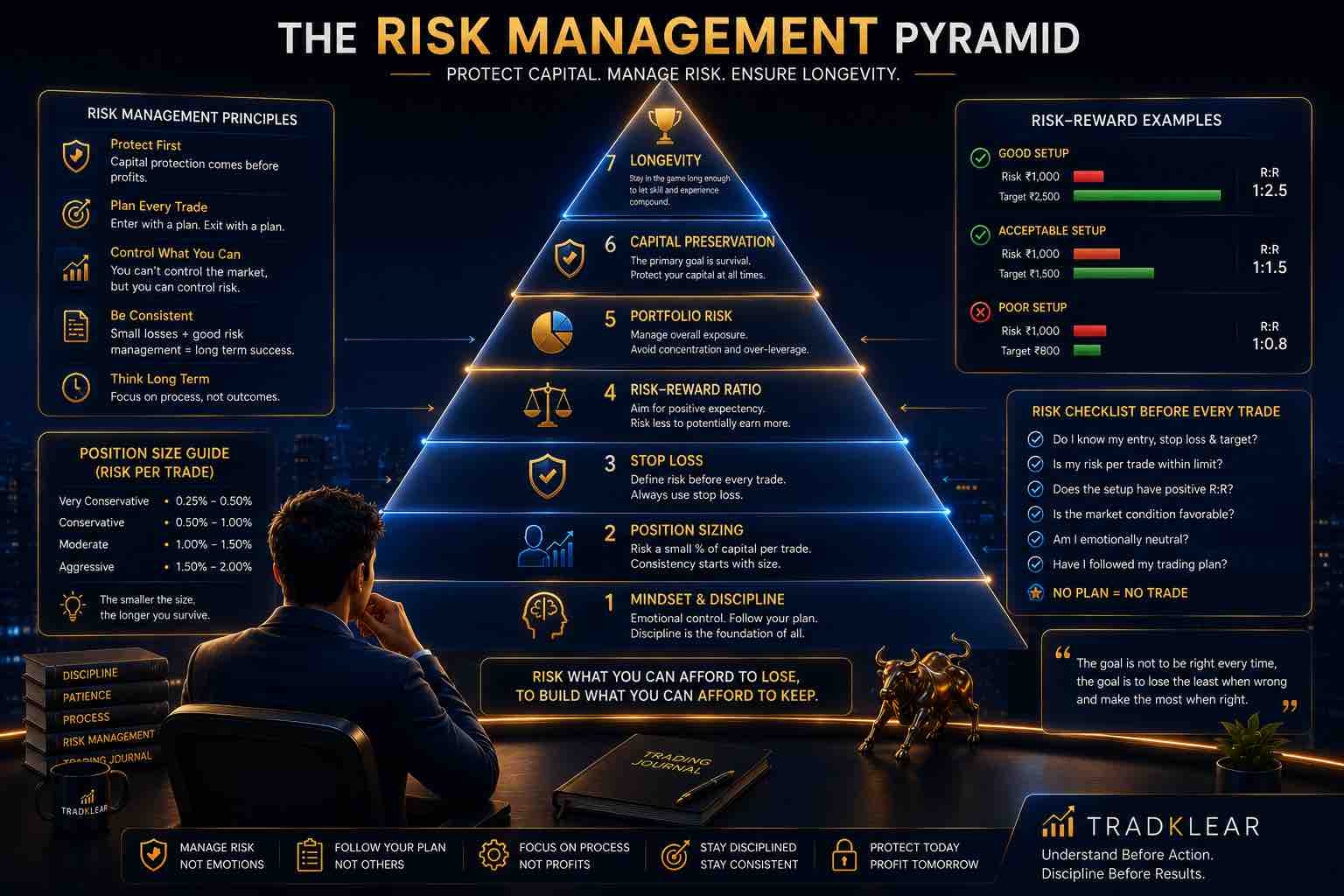
Every successful trader eventually discovers a simple truth:
You cannot benefit from future opportunities if you lose the ability to participate today.
Strategies evolve. Markets change. Volatility expands and contracts. Even experienced professionals experience losing trades.
What allows them to continue is not perfect prediction.
It is disciplined risk management.
Losses are an unavoidable part of financial markets.
Permanent capital destruction does not have to be.
Risk management is not about avoiding every loss.
It is about controlling the size of losses so they never become catastrophic.
The objective is survival first.
Everything else comes afterwards.
Position Sizing — Deciding How Much to Risk
Position sizing determines how much capital you expose to a single trading or investment idea.
Many beginners focus almost entirely on identifying the “right” entry price.
Experienced market participants understand that position size often has a greater impact on long-term results than entry precision.
A well-planned position sizing framework ensures that no single decision can significantly damage your capital.
Thinking in Risk Rather Than Investment Amount
Professional traders usually begin by deciding how much they are prepared to lose if the trade does not work as expected.
Only then do they calculate the position size.
For example:
- Trading Capital: ₹1,00,000
- Maximum Risk Per Trade: 1%
- Maximum Acceptable Loss: ₹1,000
Once the acceptable risk is defined, the position size is adjusted according to the planned stop-loss distance.
This approach keeps risk consistent regardless of which stock or instrument is traded.
The emphasis is not on how much money is invested.
It is on how much capital is genuinely at risk.
Why Smaller Losses Matter
Large losses become increasingly difficult to recover from.
For example:
- A 10% loss requires approximately an 11% gain to recover.
- A 20% loss requires a 25% gain.
- A 50% loss requires a 100% gain.
The mathematics become progressively more demanding.
By limiting losses early, traders preserve both financial and psychological capital.
Risk management is therefore not merely defensive.
It creates the conditions necessary for long-term participation.
Stop Losses — Defining Your Exit Before You Enter
Every trade should begin with a clear understanding of where it will end if the market proves your analysis incorrect.
That predetermined exit is known as a stop loss.
A stop loss is not a prediction.
It is a risk management tool.
Its purpose is to prevent a manageable loss from becoming an uncontrolled one.
Mental Stops vs Physical Stops
Two broad approaches exist.
Mental Stop
The trader remembers the intended exit level but does not place an actual order.
This approach depends entirely on emotional discipline during fast-moving markets.
Physical Stop
The stop-loss order is entered directly into the trading platform.
If the specified price is reached, the system automatically executes the exit according to market conditions.
Many experienced traders prefer physical stop-loss orders because they reduce the influence of hesitation and emotional decision-making.
Stop Placement Should Follow Market Structure
A stop loss should never be placed arbitrarily.
Instead, it should relate directly to the original trade idea.
For example:
- Below an important support area in an uptrend.
- Above a significant resistance area in a downtrend.
- Beyond the price level that would invalidate the original analysis.
When the market reaches that level, the initial reasoning for the trade may no longer remain valid.
The stop therefore protects the trading process rather than simply limiting financial loss.
Trailing Stop Losses
As trades move favourably, some traders use trailing stop-loss methods to gradually protect accumulated profits.
Instead of remaining fixed, the stop adjusts as the market moves.
This allows traders to participate in longer trends while progressively reducing downside exposure.
Trailing stops are not designed to maximise profit.
They are designed to manage evolving risk.
Risk-Reward Ratio — Understanding Trade Expectancy
One of the most frequently discussed concepts in trading is the risk-reward ratio.
A ratio of 1:2 means that the potential reward is twice the planned risk.
A ratio of 1:3 means the potential reward is three times the planned risk.
These ratios are useful planning tools.
They are not guarantees of profitability.
Why Win Rate Also Matters
Suppose a trading approach risks ₹1,000 to potentially earn ₹2,000.
If ten trades produce:
- Four winners
- Six losers
The outcome would be:
- Total Loss = ₹6,000
- Total Gain = ₹8,000
Net Result = ₹2,000 before costs.
This simple illustration demonstrates that profitability depends on the relationship between:
- Win rate
- Average winning trade
- Average losing trade
Professional traders evaluate these factors collectively rather than focusing on any single metric.
Thinking in Probabilities
Every individual trade is uncertain.
Over time, however, consistent decision-making allows statistical tendencies to emerge.
Experienced traders therefore evaluate performance across dozens or hundreds of trades—not one isolated result.
Risk-reward ratios help create positive asymmetry.
Discipline allows that asymmetry to compound over time.
Trade Risk and Portfolio Risk
Risk exists at more than one level.
Most beginners think only about the risk of an individual trade.
Professionals also consider the overall risk of their portfolio.
Diversification
Diversification reduces exposure to risks affecting individual companies.
Owning businesses across different industries may reduce the impact of company-specific events.
However, diversification cannot eliminate broader market risk.
During major market declines, many assets may still fall together.
Correlation Matters
Holding multiple positions does not automatically create diversification.
Suppose an investor owns shares in five different banking companies.
Although the portfolio contains five stocks, all may respond similarly to changes in interest rates or banking regulations.
The positions are therefore highly correlated.
Professionals evaluate overall exposure, not simply the number of holdings.
True diversification comes from owning assets that behave differently under changing market conditions.
The Risk That Ends Trading Careers
Every trader experiences losing trades.
Only a small number experience catastrophic losses.
Catastrophic loss usually results from a combination of:
- Excessive leverage
- Oversized positions
- Ignoring stop losses
- Averaging down repeatedly
- Emotional decision-making after losses
One uncontrolled trade can erase months—or even years—of disciplined work.
Leverage deserves particular respect.
While it can amplify gains, it increases losses just as quickly.
Small market movements can produce disproportionately large changes in account value.
Professionals therefore approach leverage cautiously and only within clearly defined risk limits.
Risk Management Is a Habit, Not a Tool
Many beginners view risk management as something added after selecting a strategy.
Professionals think differently.
Risk management forms the foundation upon which every strategy is built.
Position sizing.
Stop losses.
Risk-reward planning.
Portfolio diversification.
Capital preservation.
These are not isolated techniques.
Together, they create a complete framework that allows traders and investors to continue learning despite inevitable setbacks.
Markets will always remain uncertain.
Risk management allows uncertainty to remain manageable.
Once participants learn how to protect their capital, the next challenge becomes protecting something equally important—the quality of their decisions.
That challenge begins with trading psychology.
Trading Psychology — Why Your Mind Matters More Than Your Market Knowledge
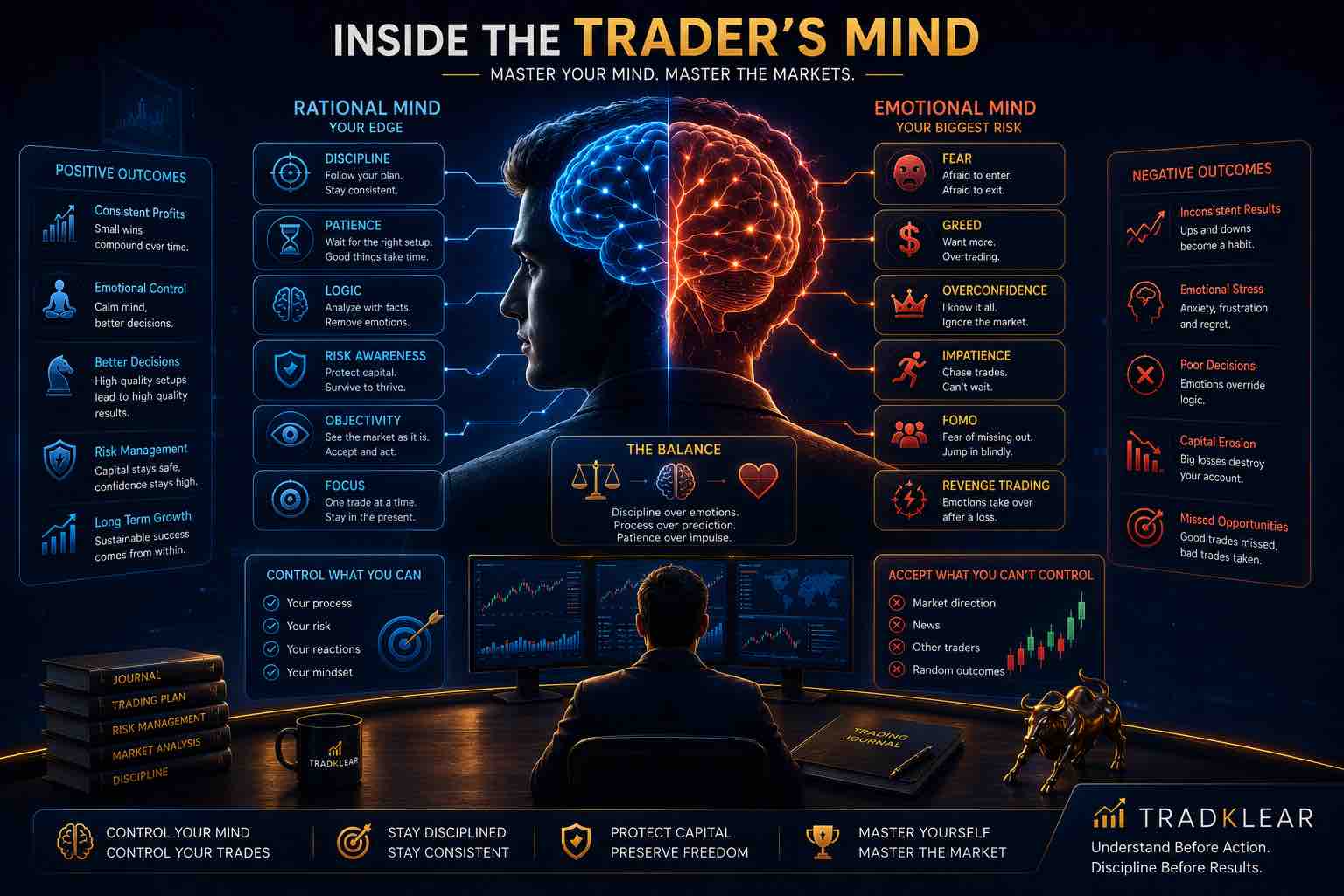
Many beginners believe success in the stock market comes from finding the right indicator, the perfect strategy, or access to better information.
Knowledge certainly matters.
But knowledge alone does not protect capital.
Over time, experienced market participants discover that the greatest challenge is rarely the market itself.
It is the person making decisions within that market.
Prices move unexpectedly.
News changes sentiment.
Winning streaks build confidence.
Losing streaks create doubt.
Markets constantly test emotional discipline.
Understanding trading psychology does not eliminate emotion.
It helps prevent emotion from controlling decisions.
Understanding the Psychology Behind Market Decisions
Every financial decision is influenced by both logic and emotion.
Developing sound decision-making and judgement helps traders evaluate opportunities more objectively across different market environments.
Even highly experienced traders experience fear, excitement, frustration, confidence, and uncertainty.
The difference is not the absence of emotion.
It is the presence of structure.
Professional traders accept that emotions are natural.
Rather than attempting to suppress them, they design processes that prevent emotions from dictating behaviour.
Psychology therefore becomes an important component of risk management.
Common Cognitive Biases That Affect Traders
Behavioural finance has identified several cognitive biases that repeatedly influence financial decision-making.
Recognising these tendencies is often the first step towards reducing their impact.
Loss Aversion
People generally experience the pain of losing money more intensely than the satisfaction of making an equivalent gain.
In trading, this often leads to:
- Holding losing positions for too long.
- Closing profitable positions too early.
- Avoiding necessary losses in the hope that prices will recover.
The market, however, does not respond to hope.
It responds to supply, demand, and changing expectations.
Confirmation Bias
Once people develop a market opinion, they naturally begin searching for information that supports their existing belief.
Information that challenges that belief is often ignored.
For example, a trader who becomes strongly bullish on a company may pay attention only to positive news while dismissing weakening financial performance or deteriorating price action.
Balanced decision-making requires actively considering evidence that challenges existing assumptions.
Overconfidence
Several profitable trades in succession can create the illusion of exceptional skill.
Confidence gradually becomes certainty.
Position sizes increase.
Risk controls become more relaxed.
Markets often correct overconfidence far more quickly than they reward it.
Maintaining discipline after success is frequently more difficult than maintaining discipline after failure.
Recency Bias
The human mind naturally places excessive importance on recent events.
After several weeks of rising markets, it becomes easy to believe prices will continue rising indefinitely.
After sharp declines, many assume markets will never recover.
Financial markets rarely move in straight lines forever.
Maintaining historical perspective helps reduce emotional reactions to recent price movements.
Herd Behaviour
Humans naturally feel safer acting alongside others.
Financial markets amplify this tendency.
Social media, television discussions, messaging groups, and market commentary often create the impression that “everyone” shares the same opinion.
Popular opinions are not necessarily correct.
Professionals develop independent frameworks for evaluating market conditions rather than relying solely on crowd sentiment.
Process Versus Outcome — The Professional Mindset
One of the most important distinctions in trading is the difference between decision quality and trade outcome.
A profitable trade is not automatically a good decision.
A losing trade is not automatically a poor decision.
Consider two examples.
A trader ignores risk management, enters a random position, and earns a profit because unexpected news pushes the price higher.
The outcome is positive.
The decision-making process remains poor.
Now consider another trader who:
- Follows a written plan.
- Calculates position size carefully.
- Places an appropriate stop loss
- Accepts a small predefined loss when the market moves against the trade.
The outcome is negative.
The process remains excellent.
Professional traders evaluate themselves primarily by the quality of their decisions—not by the result of any single trade.
Consistently good decisions create sustainable performance.
Isolated outcomes do not.
Building Discipline Through Systems
Many people believe discipline depends on motivation.
In reality, motivation changes from day to day.
Discipline develops through repeatable systems.
A structured trading routine may include:
- A written trading plan.
- Daily market preparation.
- Entry and exit checklists.
- Position sizing rules.
- Risk limits
- A trading journal.
- Scheduled performance reviews.
These systems reduce the number of decisions that need to be made under emotional pressure.
The fewer emotional decisions required during market hours, the more consistent behaviour becomes.
Professionals rely on preparation rather than willpower.
Why Keeping a Trading Journal Matters
One of the simplest yet most effective ways to improve decision-making is maintaining a trading journal.
A journal transforms experience into structured feedback.
Instead of relying on memory, traders record:
- The reason for entering a trade.
- Market conditions.
- Position size.
- Risk level.
- Emotional state before, during, and after the trade.
- Lessons learned from the outcome.
Over time, recurring behavioural patterns become easier to identify.
Many traders discover that their biggest weaknesses are not technical.
They are psychological.
Journaling makes those patterns visible.
Visible patterns can be improved.
Managing Losses Without Losing Control
Losses are an unavoidable part of participating in financial markets.
The challenge is not avoiding losses altogether.
It is responding to them constructively.
After a losing trade, many beginners experience a predictable emotional sequence:
- Disbelief
- Hope
- Frustration
- Self-doubt
- Urgency to recover quickly
Without discipline, this often leads to impulsive decision-making.
Professionals interrupt this cycle deliberately.
They step away.
Review the trade objectively.
Determine whether the trading plan was followed.
Then prepare for the next opportunity without attempting to immediately recover previous losses.
Losses should become learning experiences—not emotional emergencies.
Emotional Consistency Is a Competitive Advantage
Markets reward consistency far more than emotional intensity.
The objective is not to become emotionless.
The objective is to remain emotionally stable regardless of short-term outcomes.
A disciplined trader responds similarly after:
- A profitable trade.
- A losing trade.
- A winning streak.
- A losing streak.
That emotional consistency protects judgement.
As knowledge increases, psychology often becomes the factor that separates long-term participants from those who leave the markets prematurely.
Technical skills can be learned.
Emotional discipline must be developed through repeated practice.
Understanding markets begins with education.
Remaining in the markets depends on behaviour.
With a stronger understanding of how psychology influences decision-making, the next challenge is learning how to interpret the constant flow of financial information without becoming overwhelmed by headlines, opinions, and market noise.
Reading Financial News Without Getting Distracted
Modern financial markets operate in an environment of constant information.
Television channels broadcast live market updates throughout the day. Financial websites publish breaking news every few minutes. Social media platforms circulate opinions almost instantly. Messaging groups share rumours, forecasts, and trading ideas around the clock.
For beginners, the volume of information can feel overwhelming.
Professional market participants approach information differently.
They understand that having more information does not automatically lead to better decisions.
The real advantage comes from knowing what deserves attention—and what can safely be ignored.
Learning to filter information is an essential part of becoming a disciplined market participant.
News Versus Noise
Not every headline deserves the same level of attention.
Some information genuinely changes how markets assess risk.
Much of it simply creates short-term emotional reactions.
Understanding the difference helps prevent impulsive decisions.
Information That Often Matters
Certain developments can influence market expectations because they affect businesses, liquidity, or the broader economy.
Examples include:
- Quarterly corporate earnings
- Monetary policy announcements
- Inflation data
- GDP releases
- Regulatory changes
- Corporate actions such as mergers, acquisitions, or leadership changes
- Significant geopolitical developments
These events may influence how market participants reassess future expectations.
Information That Often Creates Noise
Other forms of information generate attention without necessarily improving understanding.
Examples include:
- Unverified market rumours
- “Guaranteed” trading tips
- Viral social media posts
- Anonymous messaging group forwards
- Sensational television debates
- Profit screenshots without context
These sources often encourage emotional reactions rather than thoughtful analysis.
Professionals develop the habit of asking one simple question:
Does this information genuinely change my understanding of risk or market structure?
If the answer is no, it usually deserves far less attention.
Understanding Corporate Earnings
Quarterly earnings announcements are among the most closely watched events in equity markets.
These reports provide insight into how businesses have performed over a specific reporting period.
Investors and analysts generally review information such as:
- Revenue
- Operating profit
- Net profit
- Profit margins
- Cash flow
- Management commentary
- Future business outlook
Many beginners assume that strong earnings automatically lead to higher share prices.
Markets are rarely that straightforward.
Markets React to Expectations
Share prices often respond less to the published numbers themselves and more to how those numbers compare with existing market expectations.
For example:
- A company may report record profits, yet its share price may fall if investors expected even stronger results.
- Another company may report only modest growth, but its share price may rise because expectations had been considerably lower.
Markets continuously compare reality with expectations.
That comparison often drives short-term price movement.
Understanding this principle helps beginners avoid confusion when seemingly “good news” is followed by falling prices.
Economic Indicators Every Beginner Should Know
Financial markets respond not only to individual companies but also to broader economic conditions.
Several economic indicators regularly influence investor sentiment in India.
Gross Domestic Product (GDP)
GDP measures the overall growth of the economy.
Changes in economic growth expectations can influence corporate earnings expectations, consumer spending, and investment activity.
Consumer Price Index (CPI)
CPI measures inflation.
Higher inflation may influence interest-rate decisions and affect both businesses and consumers.
Inflation data therefore receives close attention from financial markets.
Index of Industrial Production (IIP)
The IIP measures industrial activity across manufacturing, mining, and electricity sectors.
Although not every market participant analyses IIP data in detail, it provides useful insight into the strength of industrial production within the economy.
Why RBI Policy Matters
The Reserve Bank of India (RBI) plays a central role in India’s financial system.
Through monetary policy, the RBI influences:
- Interest rates
- Banking liquidity
- Credit conditions
- Inflation management
Changes in monetary policy can affect borrowing costs for businesses and consumers, influencing economic activity and market sentiment.
Professionals monitor RBI announcements to understand how the broader economic environment may be changing.
They do not attempt to predict every market reaction.
Government Policies and Financial Markets
Government policy also influences market behaviour.
Examples include:
- Union Budget announcements
- Taxation changes
- Infrastructure spending
- Foreign investment policies
- Sector-specific regulations
- Public sector reforms
Some policies affect only particular industries.
Others influence the broader economy.
Rather than reacting emotionally to headlines, experienced market participants focus on understanding how policy changes may alter business conditions over time.
Consuming Financial Media Responsibly
Financial media serves an important purpose.
It helps market participants stay informed about current developments.
However, information should never replace independent thinking.
Professional market participants generally follow several principles:
- Verify important information through official or primary sources whenever possible.
- Distinguish factual reporting from personal opinion.
- Avoid making decisions based solely on television debates or social media discussions.
- Be cautious of anyone claiming certainty about future market movements.
- Recognise that by the time a major news story reaches mainstream media, markets may already have reacted.
Information supports analysis.
It should not replace it.
Building a Healthy Information Routine
One of the most valuable habits beginners can develop is creating a structured approach to consuming financial information.
A practical routine might include:
- Reviewing important market developments once or twice each day rather than continuously monitoring news.
- Following official announcements from recognised institutions.
- Reading a small number of reliable financial publications instead of dozens of conflicting opinions.
- Maintaining curiosity while remaining sceptical of extraordinary claims.
More information does not necessarily produce better decisions.
Better filtering usually does.
Learn to Think Before You React
Financial markets generate an endless stream of information.
Some of it genuinely changes the investment landscape.
Much of it simply creates temporary excitement.
Successful market participants do not attempt to follow everything.
They develop the ability to distinguish between information that improves decision-making and information that merely distracts them.
That ability becomes increasingly valuable as markets grow more complex.
Once you learn to filter information effectively, the next step is transforming knowledge into practical learning.
That begins with a structured plan for your first 90 days in the market.
Your First 90 Days in the Stock Market — A Structured Learning Plan
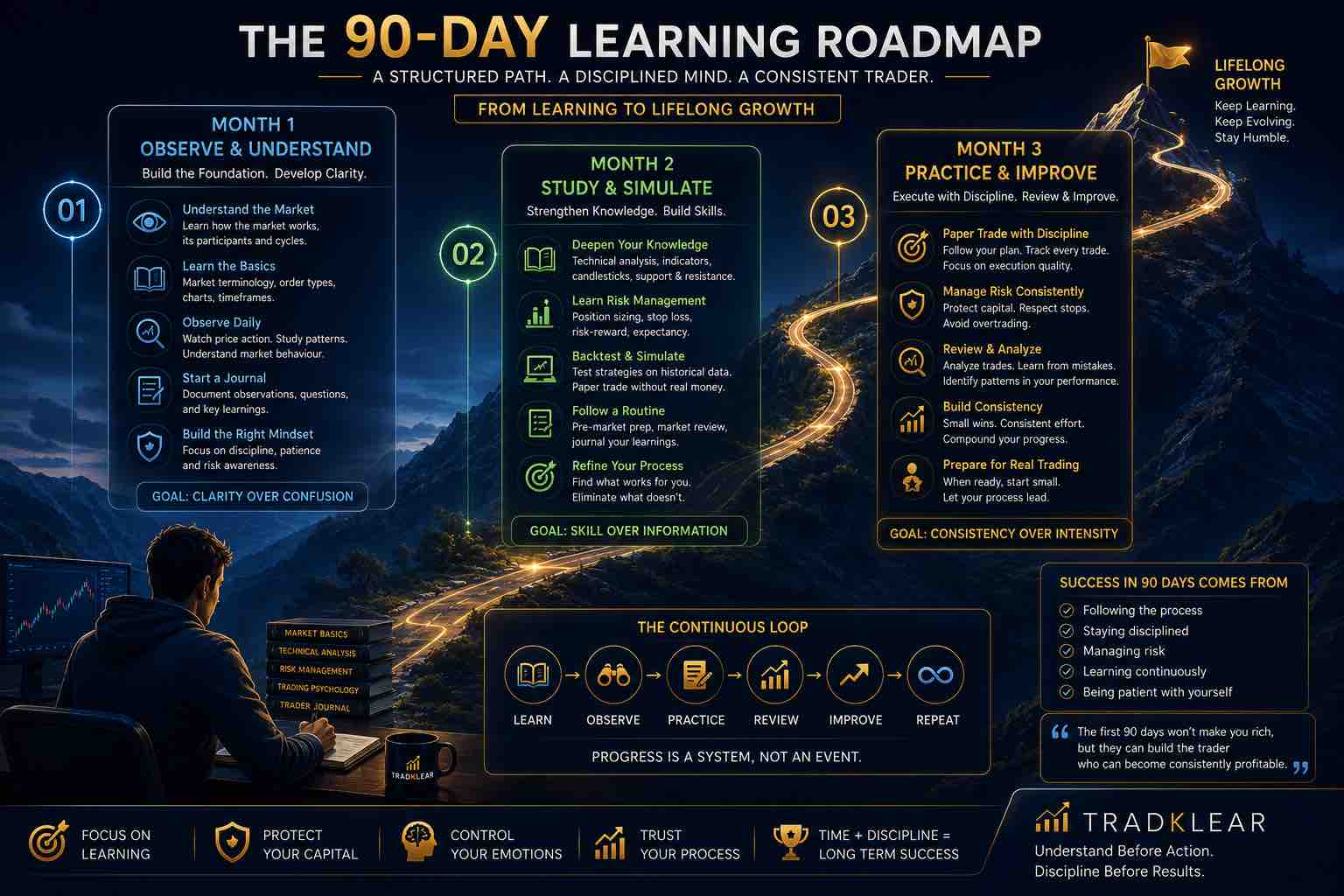
One of the biggest mistakes beginners make is believing they need to start trading immediately.
They do not.
Successful market participation begins with learning, observing, and developing good habits long before consistent results become possible.
The first 90 days should not be viewed as a race to make money.
They should be viewed as an opportunity to build a solid foundation.
These three months are about developing knowledge, discipline, and self-awareness—not chasing profits.
A structured approach during this period helps prevent many of the mistakes that discourage beginners from continuing their learning journey.
Month One — Observe Before You Participate
The first month should focus almost entirely on observation.
Rather than rushing to place trades, spend time understanding how the market behaves throughout a normal trading day.
Observe:
- How the market opens.
- How prices react during the first hour.
- How different sectors perform.
- How market sentiment changes after important news.
- How volatility increases and decreases during the session.
Choose one or two highly liquid stocks—or simply follow a broad market index such as the Nifty 50.
Watching the same instruments consistently helps you recognise recurring patterns and develop familiarity with market behaviour.
No capital needs to be committed during this stage.
Observation without financial pressure allows you to learn objectively.
Month Two — Build Knowledge Systematically
Once you become familiar with market behaviour, begin studying one concept at a time.
Avoid trying to learn everything simultaneously.
Instead, focus on building depth.
Examples include:
- Understanding market trends.
- Learning support and resistance.
- Reading basic financial statements.
- Understanding candlestick behaviour.
- Studying market indices.
- Learning basic risk management principles.
Choose one topic.
Study it thoroughly.
Then observe how it appears in live market conditions.
Depth almost always produces greater understanding than attempting to cover dozens of unrelated topics at once.
Begin Paper Trading
If you wish to gain practical experience during this stage, consider using paper trading.
Paper trading allows you to simulate trades without risking real money.
Use it to practise:
- Planning entries.
- Defining stop losses.
- Calculating position sizes.
- Recording trade ideas.
- Reviewing completed trades.
Remember that paper trading cannot fully replicate the emotions of trading with real capital.
Its purpose is educational.
Not predictive.
Month Three — Introduce Limited Real Experience
Only after developing a basic understanding should beginners consider using real capital.
Even then, the objective remains learning.
Not maximising returns.
If you decide to place live trades:
- Use the smallest practical position size.
- Focus on following your process rather than making profits.
- Accept that mistakes are part of learning.
- Keep expectations realistic.
Real money introduces emotions that paper trading cannot reproduce.
Experiencing those emotions while risking only a small amount of capital provides valuable learning without creating unnecessary financial pressure.
Keep a Learning Journal from Day One
One of the most valuable habits you can develop is maintaining a written learning journal.
The purpose is not simply to record trades.
It is to record your thinking.
Each journal entry may include:
- Date
- Market or instrument observed
- What you expected to happen
- What actually happened
- Lessons learned
- Questions for further study
- Emotional observations
Over time, the journal becomes a record of your development.
Patterns begin to emerge.
Mistakes become easier to identify.
Improvements become measurable.
Professionals review their journals regularly because learning compounds through reflection.
How to Measure Progress
Many beginners evaluate progress using only one measure:
Profit.
This often creates unrealistic expectations.
During your first 90 days, more meaningful indicators include:
- Do you understand more market concepts than you did one month ago?
- Are you making decisions more calmly?
- Are you following your own rules more consistently?
- Are you recognising common mistakes more quickly?
- Has your confidence become based on understanding rather than excitement?
These improvements often matter far more than short-term financial results.
Competence develops before consistency.
Consistency develops before confidence.
Signs That You Are Ready to Progress
By the end of the first three months, you do not need to become an expert.
You simply need to build a strong foundation.
Some positive signs include:
- You understand the basic structure of Indian financial markets.
- You appreciate the importance of risk management.
- You can explain why you entered or avoided a trade.
- You maintain a written journal.
- You no longer feel the need to trade every market movement.
- You accept that losses are part of the learning process.
These behavioural improvements indicate genuine progress.
Learning markets is not about reaching a finish line.
It is about developing better judgement over time.
Build Habits Before You Build Capital
Many beginners focus on growing capital.
Experienced traders focus on growing good habits.
Capital can fluctuate.
Well-developed habits continue creating value throughout your market journey.
The first 90 days are therefore not designed to produce extraordinary returns.
They are designed to produce extraordinary foundations.
Those foundations will support everything that follows.
As your understanding grows, you will also begin to recognise the mistakes that repeatedly trap new market participants.
Learning to avoid those mistakes is the next important step.
Common Stock Market Mistakes Beginners Should Avoid
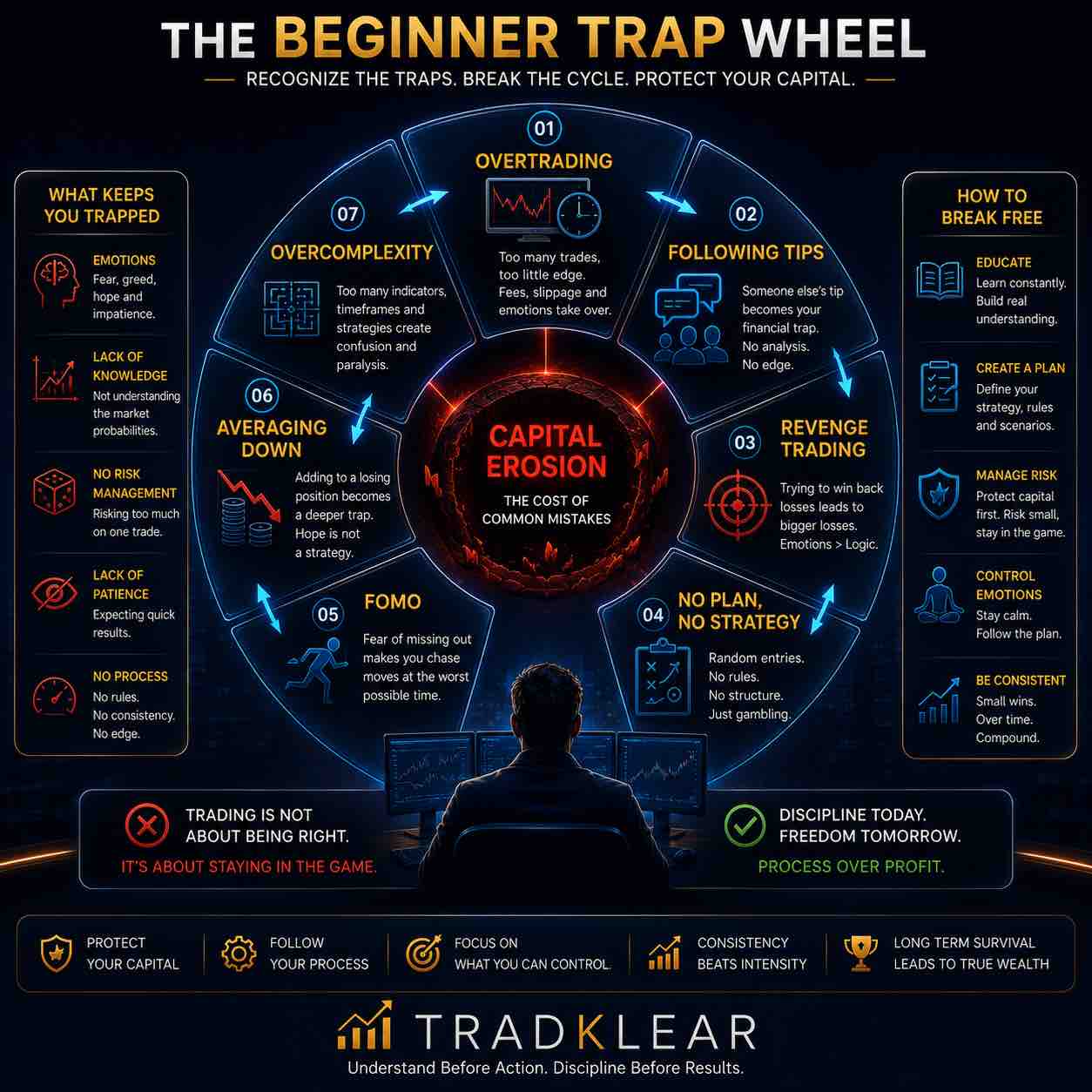
Every beginner enters the market with optimism.
That optimism is valuable.
It encourages curiosity, learning, and the willingness to begin.
Without structure, however, optimism can quickly turn into frustration.
Most beginners do not struggle because financial markets are impossible to understand.
They struggle because they repeatedly encounter the same avoidable mistakes.
These mistakes have remained remarkably consistent across different market cycles, asset classes, and generations of traders.
Learning to recognise them early can save both capital and confidence.
Avoiding mistakes alone will not guarantee success.
It will, however, give you far more opportunities to continue learning.
Overtrading
One of the most common beginner mistakes is trading too frequently.
Many new traders assume that more trades automatically create more opportunities.
In reality, more trades often create:
- Higher transaction costs.
- Greater emotional fatigue.
- Reduced decision quality.
- Increased exposure to unnecessary risk.
Financial markets provide opportunities every day.
They do not require participation every day.
Professional traders understand that patience is a competitive advantage.
Sometimes the highest-quality decision is choosing not to trade at all.
Activity should never be confused with progress.
Averaging Down Without a Structured Plan
Averaging down means increasing a position after its price has fallen in order to reduce the average purchase price.
Although this may appear logical, it can become extremely risky when performed without a clearly defined investment thesis and disciplined risk management.
For short-term traders, averaging down often reflects hope rather than analysis.
Increasing exposure simply because a position has moved against you can transform a manageable loss into a much larger one.
Long-term investors sometimes add to existing investments after careful analysis of business fundamentals.
Even then, the decision is usually made within a predefined portfolio strategy rather than as an emotional reaction.
The important lesson is simple:
Never increase risk merely because a position is losing.
Following Tips Instead of Building Understanding
The internet provides unlimited access to opinions.
Unfortunately, not all opinions deserve equal attention.
Beginners frequently encounter:
- Social media recommendations.
- Messaging group “calls”.
- Anonymous market rumours.
- Claims of guaranteed profits.
- Screenshots showing exceptional returns without context.
These sources rarely explain:
- Why a position should be taken.
- How much capital should be risked.
- Where to exit if the market moves differently.
- What assumptions support the idea.
Following tips may occasionally produce positive outcomes.
It rarely develops independent judgement.
Professionals aim to understand markets for themselves rather than relying entirely on someone else’s conviction.
Knowledge creates confidence.
Dependence creates vulnerability.
Ignoring Costs and Taxes
Many beginners focus exclusively on gross profits.
Actual returns are influenced by several additional factors.
Trading and investing may involve costs such as:
- Brokerage charges.
- Securities Transaction Tax (STT).
- Exchange transaction charges.
- GST.
- Stamp duty.
- Depository Participant (DP) charges, where applicable.
Taxation also influences overall returns.
The applicable tax treatment depends on several factors, including the type of instrument traded and the nature of the transaction.
Because tax rules can change over time and individual circumstances differ, it is important to refer to the latest official guidance or seek professional tax advice where appropriate.
Understanding total costs helps create more realistic expectations.
Trading Without a Written Plan
A written trading plan provides structure before emotions become involved.
Without one, decisions often become reactive.
A simple trading plan may define:
- Markets or instruments to trade.
- Entry conditions.
- Exit conditions.
- Position sizing rules.
- Maximum acceptable risk.
- Review process.
The objective is not to predict every market movement.
It is to ensure that every decision follows a consistent framework.
Professionals rely on written processes because memory and emotion become less reliable under pressure.
Revenge Trading
Losses can create a strong desire to recover quickly.
This emotional response is known as revenge trading.
Instead of waiting for the next high-quality opportunity, traders often:
- Increase position size.
- Ignore established rules.
- Enter lower-quality setups.
- Take unnecessary risks.
The objective quietly shifts from disciplined decision-making to emotional recovery.
Unfortunately, this often produces even larger losses.
Experienced traders recognise these emotional signals early.
Rather than trying to recover immediately, they pause.
They review what happened.
They regain emotional balance before making another decision.
Protecting judgement is often more important than recovering money.
Comparing Your Journey with Others
Modern financial media makes comparison almost unavoidable.
Beginners constantly see:
- Profit screenshots.
- Stories of rapid success.
- Extraordinary percentage returns.
- Claims of financial independence through trading.
These examples rarely present the complete picture.
They often omit:
- Years of experience.
- Previous losses.
- Risk taken.
- Capital size.
- Market conditions.
Every market participant follows a different path.
Comparing your beginning with someone else’s highlight reel creates unrealistic expectations.
Meaningful progress should be measured against your own previous understanding—not someone else’s reported results.
Turning Mistakes into Learning Opportunities
Every experienced trader has made mistakes.
The difference is that successful traders attempt to learn from them rather than repeat them.
Mistakes become valuable when they are:
- Recognised.
- Recorded.
- Reviewed.
- Corrected.
A trading journal plays an important role in this process.
It transforms mistakes from emotional experiences into educational feedback.
Improvement rarely comes from avoiding every mistake.
It comes from avoiding the same mistake repeatedly.
Progress Comes from Better Decisions
Markets continually test patience, discipline, and judgement.
The mistakes discussed in this section are common because they arise from normal human behaviour.
Recognising them early allows beginners to build healthier habits from the start.
Learning what not to do is just as valuable as learning what to do.
As your experience grows, you will naturally begin developing your own beliefs about markets, risk, and decision-making.
Those beliefs gradually evolve into something every experienced market participant possesses:
A personal market philosophy.
Developing Your Own Market Philosophy

Every beginner starts by following rules.
Over time, experienced market participants learn something equally important:
Rules provide structure.
A personal philosophy provides direction.
Strategies may change.
Market conditions will certainly change.
Your underlying principles should remain consistent.
A market philosophy is not about predicting the future.
It is about defining how you choose to participate in an uncertain environment.
The clearer your philosophy becomes, the more consistent your decision-making is likely to become.
What Is a Market Philosophy?
A market philosophy is the collection of beliefs that shapes how you think about financial markets, risk, learning, and decision-making.
It answers questions such as:
- What role should the stock market play in my financial life?
- How much uncertainty am I comfortable accepting?
- What does success mean to me?
- How important is capital preservation?
- How will I respond when markets move against me?
These answers influence every future decision.
Strategy grows from philosophy.
Not the other way around.
Accepting That Markets Are Probabilistic
One of the most important beliefs shared by experienced market participants is that financial markets operate on probabilities rather than certainty.
No analysis can guarantee an outcome.
No indicator predicts every movement.
No strategy wins every time.
Accepting uncertainty changes how decisions are made.
Instead of searching for certainty, disciplined traders focus on:
- Following their process.
- Managing risk.
- Making consistently good decisions.
- Learning from outcomes.
The objective is not to eliminate uncertainty.
It is to operate responsibly within it.
Capital Preservation Comes Before Capital Growth
Many beginners naturally focus on making money.
Professionals first focus on protecting what they already have.
Capital preservation creates opportunity.
Without capital, future opportunities cannot be used.
This mindset influences numerous decisions, including:
- Position sizing.
- Risk management.
- Instrument selection.
- Use of leverage.
- Portfolio construction.
Growing capital is important.
Preserving capital makes long-term growth possible.
Understanding Whether You Are an Investor or a Trader
Financial markets offer multiple ways to participate.
Two of the most common approaches are investing and trading.
Neither is inherently superior.
They simply serve different objectives.
Investors
Investors generally focus on:
- Long-term business growth.
- Company fundamentals.
- Wealth creation over years.
- Compounding returns.
Daily price fluctuations often receive relatively little attention.
Traders
Traders generally focus on:
- Price movement.
- Market structure.
- Defined entry and exit rules.
- Risk management.
- Shorter decision cycles.
Success depends on disciplined execution rather than long-term business ownership.
Some People Choose Both
Many experienced market participants maintain separate approaches.
For example:
- A long-term investment portfolio.
- A separate trading account with its own rules and objectives.
Keeping these activities separate often reduces emotional conflict and improves decision-making.
The important point is not choosing the “correct” approach.
It is understanding which approach best matches your goals, personality, available time, and tolerance for uncertainty.
Finding a Style That Matches Your Personality
Different trading styles suit different individuals.
Rather than copying someone else’s approach, spend time understanding your own preferences.
Intraday Trading
Intraday traders open and close positions during the same trading session.
This style generally requires:
- Continuous market monitoring.
- Quick decision-making.
- Strong emotional discipline.
- Consistent daily preparation.
Swing Trading
Swing traders typically hold positions for several days or weeks.
This approach often suits people who cannot monitor markets throughout the trading day but can review markets regularly.
Positional Trading
Positional traders usually focus on broader market trends over weeks or months.
This style often combines elements of both trading and investing.
No style guarantees better results.
The most suitable approach is usually the one that fits your temperament and lifestyle.
Successful market participation is easier when your method aligns with your personality rather than constantly working against it.
Questions Every Beginner Should Answer
As your understanding develops, it becomes useful to answer a few important questions in writing.
For example:
- Which markets or instruments do I want to understand first?
- Why am I participating in financial markets?
- How much risk am I genuinely comfortable accepting?
- How will I define success beyond profits?
- What habits do I want to develop?
- What mistakes do I want to avoid repeating?
There are no universally correct answers.
The value lies in thinking deliberately.
Writing your answers creates clarity.
Clarity improves consistency.
Your Philosophy Will Continue to Evolve
A market philosophy is not something you create once and never revisit.
It develops through experience.
Every market cycle teaches new lessons.
Every mistake improves self-awareness.
Every journal entry adds another piece to your understanding.
As knowledge grows, your philosophy becomes more refined.
That evolution is both natural and valuable.
Professionals continue learning throughout their careers.
Their principles become stronger because they are tested repeatedly under changing market conditions.
Build Principles Before Building Strategies
Strategies come and go.
Indicators become popular and then fade.
Market conditions change continuously.
Strong principles remain valuable regardless of market conditions.
If you develop a philosophy centred on:
- Continuous learning.
- Independent thinking.
- Risk awareness.
- Behavioural discipline.
- Structured decision-making.
you will possess something far more durable than any individual trading strategy.
Those principles will guide your decisions long after specific market techniques evolve.
With a clearer understanding of your own approach to markets, the next practical decision is choosing the infrastructure through which you participate.
That begins with selecting a broker and trading platform.
Choosing the Right Broker and Trading Platform
Understanding financial markets is only one part of becoming a market participant.
To buy or sell securities, you also need access to a regulated trading infrastructure.
That access is provided through a registered stockbroker and a trading platform.
For beginners, choosing a broker can feel confusing.
Dozens of firms offer similar services, competitive pricing, advanced technology, and different account features.
Rather than asking,
“Which broker is the best?”
a better question is:
“Which broker is most suitable for my needs?”
The answer depends on your objectives, trading style, and learning stage.
What Does a Stockbroker Do?
A stockbroker acts as an authorised intermediary between you and recognised stock exchanges such as the National Stock Exchange (NSE) and the Bombay Stock Exchange (BSE).
When you place an order through your trading platform, the broker routes that order to the exchange for execution.
Beyond order execution, brokers may also provide services such as:
- Trading and investing platforms.
- Demat account facilities.
- Portfolio reporting.
- Educational resources.
- Customer support.
- Research tools (where offered).
A broker provides access to the market.
Your decisions remain your responsibility.
Understanding the Different Types of Brokers
Broadly, brokers in India fall into two categories.
Full-Service Brokers
Full-service brokers typically offer a wider range of services, which may include:
- Investment research.
- Educational material.
- Relationship managers.
- Advisory products.
- Multiple financial services under one platform.
These additional services may result in higher overall costs.
Some investors value this broader support.
Others prefer a simpler approach.
Discount Brokers
Discount brokers generally focus on efficient trade execution at comparatively lower brokerage costs.
Many provide:
- Modern online platforms.
- Charting tools.
- Mobile applications.
- Basic educational resources.
- Lower transaction costs.
For many self-directed learners, this model provides sufficient functionality.
Neither category is inherently superior.
The appropriate choice depends on individual requirements.
Factors to Consider Before Opening an Account
Rather than selecting a broker based solely on advertising or popularity, evaluate several practical factors.
Regulation and Registration
Always ensure the broker is appropriately registered with the relevant regulatory authorities and operates within the applicable legal framework.
Regulatory compliance helps protect market integrity and investor confidence.
Platform Reliability
A trading platform should be:
- Stable.
- Easy to navigate.
- Responsive during market hours.
- Available across desktop and mobile devices.
Reliable technology reduces operational friction during periods of market volatility.
Brokerage and Other Charges
Brokerage is only one part of the overall cost.
Understand the complete fee structure, which may include:
- Brokerage charges.
- Annual maintenance charges (AMC), where applicable.
- Demat-related charges.
- Transaction charges.
- Other applicable statutory charges.
Reading the fee schedule before opening an account helps prevent unexpected costs later.
Research and Educational Resources
Some brokers provide learning materials, webinars, market reports, or educational content.
While these resources can be useful, they should complement—not replace—your own learning and independent analysis.
Customer Support
Technical issues occasionally occur.
Responsive customer support becomes particularly valuable during account setup, platform issues, or operational queries.
Consider whether support is available through multiple communication channels and during relevant business hours.
Understanding Trading and Demat Accounts
Beginners often confuse trading accounts and demat accounts.
Although they work together, they perform different functions.
Trading Account
A trading account allows you to place buy and sell orders on recognised stock exchanges.
It acts as the transaction interface between you and the market.
Demat Account
A demat account holds securities electronically after they have been purchased.
Instead of receiving physical share certificates, ownership is maintained digitally through the depository system.
Most investors require both accounts to participate in equity markets.
Understanding this distinction helps avoid confusion during the account-opening process.
Should Beginners Use a Demo or Paper Trading Platform?
Before risking real capital, many beginners find it helpful to become familiar with how trading platforms work.
Paper trading or simulated trading environments allow users to practise:
- Navigating the platform.
- Placing different order types.
- Understanding execution.
- Testing simple trading plans.
These simulations provide valuable operational experience.
However, they cannot fully replicate the emotions associated with trading with real money.
Use paper trading to learn the mechanics.
Use very small real positions later to learn emotional discipline.
Both stages have value.
Technology Supports Decisions—It Does Not Replace Them
Modern trading platforms offer sophisticated features, including:
- Advanced charting.
- Market scanners.
- Alerts.
- Watchlists.
- Portfolio tracking.
- Research tools.
These features improve efficiency.
They do not improve judgement.
Successful market participation depends far more on disciplined decision-making than on having the most advanced software.
Technology should support your process—not become a substitute for it.
Choose for the Long Term, Not for Marketing
Many brokers compete by promoting low brokerage, attractive interfaces, or promotional offers.
While these factors may influence your decision, they should not become the primary basis for choosing a platform.
Instead, prioritise:
- Reliability.
- Transparency.
- Ease of use.
- Educational support.
- Cost awareness.
- Regulatory compliance.
A broker is an important part of your market infrastructure.
Choosing carefully creates a smoother learning experience from the very beginning.
With your market access in place, the next step is understanding how to continue learning long after this guide is finished.
Because successful market participants never stop learning.
Resources to Continue Your Stock Market Learning
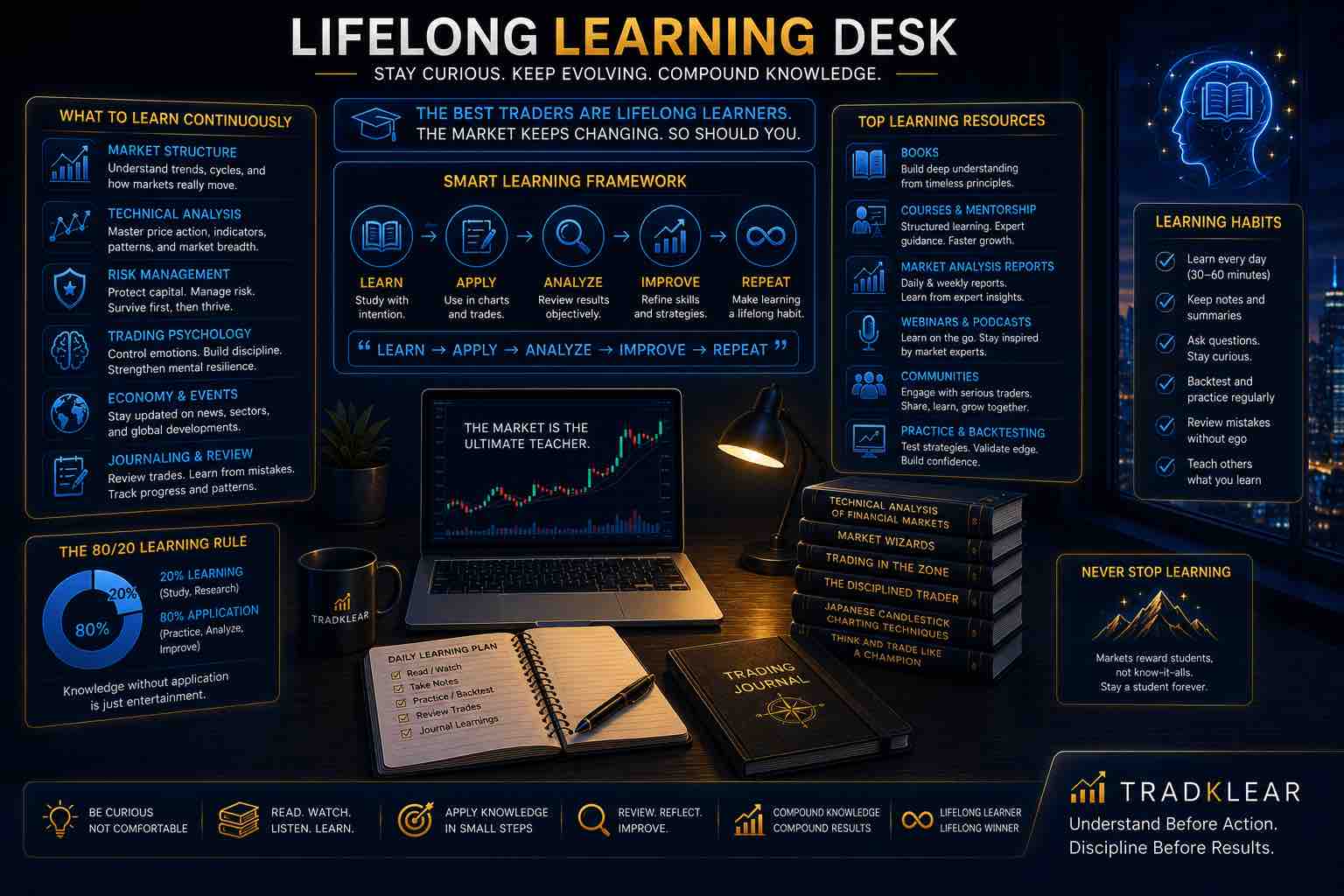
Learning the stock market is not a one-time event.
Financial markets evolve continuously.
New regulations are introduced.
Economic conditions change.
Technology advances.
Market behaviour adapts.
The most successful traders and investors recognise that learning never truly ends.
Every market cycle presents new lessons.
This guide provides a strong foundation.
Long-term progress comes from building a habit of continuous education.
Books Every Beginner Should Consider Reading
Books remain one of the most valuable ways to develop long-term understanding.
Unlike short-form online content, well-written books allow ideas to be explored with greater depth and context.
Rather than searching for a single “best” trading book, consider building knowledge across multiple areas.
Market Psychology
Understanding your own behaviour is just as important as understanding price charts.
Recommended topics include:
- Trading psychology.
- Decision-making under uncertainty.
- Behavioural finance.
- Emotional discipline.
Investing and Business Analysis
Learning how businesses create value provides important context, even for active traders.
Areas worth studying include:
- Company analysis.
- Financial statements.
- Valuation principles.
- Long-term wealth creation.
Technical Analysis
Technical analysis should be approached as a framework for interpreting market behaviour rather than predicting future prices.
Focus on understanding:
- Trends.
- Market structure.
- Price behaviour.
- Volume.
- Risk management.
Probability and Decision-Making
Markets operate under uncertainty.
Books covering probability, statistics, and decision-making often help readers develop more realistic expectations about outcomes and risk.
Learning how probabilities influence results can significantly improve judgement over time.
Learn from Reliable Sources
The internet offers almost unlimited financial content.
Unfortunately, not all of it is equally reliable.
Whenever possible, prioritise information published by recognised institutions, official organisations, and established educational sources.
Examples include:
- Official exchange websites.
- Regulatory publications.
- Central bank publications.
- Company annual reports.
- Corporate financial statements.
- Academic research.
- High-quality financial journalism.
Primary sources generally provide more reliable information than social media commentary.
Developing the habit of verifying information improves long-term decision-making.
Use Market Data to Improve Understanding
Reading about markets is valuable.
Observing markets directly is equally important.
Spend time reviewing:
- Price charts.
- Corporate announcements.
- Earnings reports.
- Economic data.
- Sector performance.
- Market indices.
The objective is not to predict every movement.
It is to improve your ability to interpret market behaviour objectively.
Knowledge develops through repeated observation.
Choose Communities That Encourage Learning
Learning alongside others can be valuable.
The quality of the community, however, matters enormously.
Healthy learning communities typically encourage:
- Questions.
- Independent thinking.
- Respectful discussion.
- Constructive feedback.
- Evidence-based analysis.
Communities become less valuable when they focus primarily on:
- Guaranteed profits.
- Constant trading tips.
- Rumours.
- Emotional hype.
- Fear of missing out (FOMO).
Healthy communities encourage learning.
Unhealthy communities encourage dependency.
Choose carefully.
Build a Habit of Keeping a Learning Journal
Earlier in this guide, we discussed maintaining a trading journal.
A learning journal expands that idea further.
Instead of recording only trades, also record:
- New concepts learned.
- Questions you still have.
- Books completed.
- Market observations.
- Behavioural insights.
- Mistakes and lessons.
Writing reinforces understanding.
Over months and years, your journal becomes one of your most valuable educational resources.
It documents your own development rather than someone else’s opinions.
Review Your Progress Regularly
Learning compounds through reflection.
Instead of measuring progress every day, consider reviewing your development periodically.
Ask yourself questions such as:
- What have I learned this month?
- Which concepts still confuse me?
- Am I following my own rules more consistently?
- Which mistakes occur repeatedly?
- What should I study next?
Regular review helps transform information into understanding.
Improvement becomes intentional rather than accidental.
Build Your Own Learning System
Successful market participants rarely depend on a single source of knowledge.
Instead, they gradually build a personal learning system.
That system may include:
- Books.
- Market observation.
- Official publications.
- Journaling.
- Educational articles.
- Structured courses.
- Thoughtful discussion with other learners.
No individual resource provides every answer.
Combining multiple reliable sources creates a broader and more balanced understanding.
The objective is not to know everything.
It is to continue learning consistently.
Lifelong Learning Is One of the Greatest Market Advantages
Financial markets reward adaptability.
Those who continue learning are generally better prepared for changing market conditions than those who stop developing after acquiring a few techniques.
Knowledge compounds.
Experience compounds.
Reflection compounds.
Over time, these improvements become difficult to notice day by day.
Viewed across years, however, they often make a remarkable difference.
Learning does not end when this guide finishes.
In many ways, it has only just begun.
The final step is bringing everything together and understanding where to go from here.
Where to Go from Here
Reaching the end of this guide does not mean your learning journey is complete.
It means you have built a strong foundation upon which deeper understanding can grow.
You now understand:
- How the Indian stock market functions.
- The different financial instruments available.
- The foundations of technical and fundamental analysis.
- Why risk management comes before returns.
- How psychology influences market decisions.
- Why structured learning matters more than shortcuts.
- The importance of developing your own market philosophy.
These concepts are not isolated lessons.
Together, they form the framework upon which disciplined market participation is built.
Learning becomes much easier once the fundamentals are firmly in place.
Continue Building Your Knowledge Gradually
One of the biggest misconceptions about financial markets is that expertise develops quickly.
In reality, meaningful progress is usually the result of consistent learning over an extended period.
You do not need to master every concept immediately.
Instead, continue building your understanding one step at a time.
Observe markets regularly.
Review your journal.
Study new topics.
Reflect on your decisions.
Allow experience to reinforce what you have learned.
Small improvements made consistently often produce far greater long-term progress than periods of intense but inconsistent effort.Strengthen Your Foundation Before Increasing Complexity
As your confidence grows, there may be a temptation to explore increasingly complex strategies or financial instruments.
Progress thoughtfully.
A strong understanding of market structure, risk management, and behavioural discipline will usually contribute far more to long-term success than constantly searching for more advanced techniques.
Complexity should be added only after the fundamentals become second nature.
Professionals rarely outgrow the basics.
They continually refine them.
The Next Step in the TradKlear Learning Journey
This guide has been designed to provide a comprehensive introduction to learning stock market trading in India.
For readers who wish to continue developing their understanding through a more structured educational pathway, TradKlear’s Learning Path organises important topics into a logical sequence so that each stage builds naturally upon the previous one.
As your understanding develops further, the 90-Day Market Survival Framework explores many of the principles introduced in this guide in greater depth, including market observation, behavioural discipline, risk management, journaling, and structured practice.
Neither resource is intended as a shortcut to market success.
Both are designed to support thoughtful, independent learning through a structured educational process.
Learning Is a Continuous Process
Financial markets never stop changing.
New economic conditions emerge.
Industries evolve.
Technology advances.
Regulations develop.
Successful market participants continue learning because the environment itself continues changing.
Curiosity therefore becomes one of your greatest long-term advantages.
Every market cycle provides opportunities to strengthen your understanding.
Every experience—whether positive or challenging—can become part of your education when approached thoughtfully.
Build Understanding Before Chasing Results
Many people enter financial markets hoping to achieve quick outcomes.
Those who remain for the long term often discover something more valuable.
The quality of your decisions usually improves before the quality of your results.
Knowledge develops first.
Judgement follows.
Consistency comes later.
Allow yourself the time to build each stage properly.
Markets reward disciplined learning far more reliably than rushed participation.
The Journey Has Only Begun
Completing this guide means you now possess something many beginners never develop:
A structured foundation.
You understand that markets involve uncertainty.
You appreciate the importance of risk management.
You recognise the influence of psychology.
You have a framework for continuing your education independently.
That foundation will remain valuable regardless of how markets evolve in the years ahead.
Learning the stock market is not about reaching a destination.
It is about becoming progressively more thoughtful, disciplined, and informed with every stage of the journey.
The final section brings together everything discussed throughout this guide and leaves you with one lasting idea that will continue to guide your market education.
Conclusion — Build Knowledge First, Results Later
Learning the stock market is not about finding a secret strategy, predicting every market movement, or making perfect decisions.
It is about developing the knowledge, judgement, and discipline needed to participate responsibly in an environment where uncertainty is always present.
Throughout this guide, you have explored the foundations of market participation.
You have learned:
- How the Indian stock market works.
- The different financial instruments available.
- The principles of technical and fundamental analysis.
- Why risk management is essential.
- How psychology influences decision-making.
- How to filter information more effectively.
- The importance of structured learning and continuous improvement.
Each topic builds upon the one before it.
Together, they create a framework for approaching financial markets thoughtfully rather than emotionally. If you would like to see how these principles come together into a single learning philosophy, Trade With Clarity: Blueprint for Every Beginner Trader explores that journey in greater depth.
Perhaps the most important lesson is this:
Markets reward preparation more consistently than prediction.
No article, strategy, indicator, or educator can remove uncertainty from financial markets.
What education can do is help you understand uncertainty, manage risk more effectively, and make better-informed decisions over time.
That is a far more realistic—and ultimately more valuable—goal.
As you continue your learning journey, remember the three principles that have appeared throughout this guide:
- Respect risk.
- Understand your behaviour.
- Follow a structured process.
These principles remain relevant regardless of market conditions, trading style, or level of experience.
If you continue building knowledge patiently, reviewing your decisions honestly, and refining your approach consistently, you will develop something far more valuable than a collection of trading techniques.
You will develop sound judgement.
And in financial markets, sound judgement is one of the strongest foundations upon which long-term progress can be built.
Thank you for taking the time to read this guide.
We hope it has helped you better understand not only how financial markets work, but also how to approach them with greater clarity, discipline, and responsibility.
If you would like to continue building your knowledge, the TradKlear Learning Path provides a structured roadmap that brings together our educational articles and learning resources in a logical sequence, helping you progress step by step.
When you are ready to move beyond self-directed learning, explore the 90-Day Market Survival Framework—a structured educational framework designed to help beginners build market understanding, disciplined decision-making, and long-term trading habits through a guided learning process.
Learning begins with curiosity.
Progress comes through consistent understanding.
The journey is yours to continue.
Frequently Asked Questions - (FAQs)
How much money do I need to start stock market trading in India?
There is no fixed minimum amount required by the stock exchanges to begin trading or investing. The amount of capital you need depends on the financial instrument you choose, your risk management approach, and your learning objectives. Beginners are generally better served by starting with an amount they can afford to learn with rather than focusing on maximising returns.
What is the best way for beginners to learn stock market trading?
The most effective approach is to build a strong foundation before risking significant capital. Begin by understanding how financial markets work, study basic technical and fundamental analysis, learn risk management principles, observe live markets, maintain a learning journal, and practise with a structured plan. Consistent education usually produces better long-term results than searching for shortcuts.
Can I learn stock market trading without paying for a course?
Yes. Many high-quality educational resources are available through books, official exchange publications, company annual reports, regulatory websites, and structured self-study. Paid education is optional. What matters most is following a logical learning process and applying knowledge consistently.
Is stock market trading legal in India?
Yes. Trading and investing in recognised financial instruments are legal in India when conducted through registered stockbrokers on recognised exchanges operating within the applicable regulatory framework.
What is the difference between trading and investing?
Investing generally focuses on long-term ownership of businesses with the expectation of creating wealth over time. Trading focuses on shorter-term price movements using predefined entry, exit, and risk management rules. Both approaches require discipline but differ in objectives, time horizon, and decision-making processes.
Should beginners start with stocks or options?
For most beginners, learning through equity shares is generally a simpler starting point because it helps develop an understanding of business ownership, price behaviour, and market structure without the additional complexity of leveraged derivative products. Building strong fundamentals first often makes learning more advanced instruments easier later.
Do I need a Demat account to invest in shares?
Yes. In India, listed shares are held electronically through a Demat account. Most investors require both a trading account for executing transactions and a Demat account for holding securities after purchase.
Should I use paper trading before investing real money?
Paper trading can be a useful way to become familiar with trading platforms, order types, and basic market mechanics without financial risk. However, it cannot fully replicate the emotions associated with real capital. Many beginners benefit from combining paper trading with a gradual transition to very small live positions once they have developed a basic understanding.
Is technical analysis enough to become a successful trader?
Technical analysis is an important analytical framework, but it is only one part of disciplined market participation. Long-term development also requires risk management, emotional discipline, structured decision-making, continuous learning, and an understanding of broader market context.
Is stock market trading risky?
Yes. All financial markets involve risk, including the possibility of partial or complete capital loss. Risk cannot be eliminated, but it can be managed through education, disciplined position sizing, diversification where appropriate, and consistent risk management practices.
Can I trade while working a full-time job?
Yes. The most suitable approach depends on your available time. Many people with full-time careers choose longer-term investing or swing trading because these approaches generally require less continuous market monitoring than intraday trading.
What is the biggest mistake beginners make?
One of the most common mistakes is focusing on making money before developing a solid understanding of how financial markets work. Rushing into trading without learning about risk management, market behaviour, and emotional discipline often leads to avoidable mistakes. Building knowledge before increasing exposure generally creates a stronger long-term foundation.
How long does it take to learn stock market trading?
Learning the stock market is an ongoing process rather than something completed within a fixed period. Most beginners can develop a solid foundation within a few months of structured study, but developing sound judgement, discipline, and consistency typically requires continuous learning and practical experience over a much longer period.
Disclaimer
The information provided in this article is intended solely for educational and informational purposes. It has been prepared to help readers develop a better understanding of financial markets, investing, trading concepts, risk management, and market behaviour.
Nothing in this guide should be interpreted as investment advice, trading advice, financial planning advice, stock recommendations, research recommendations, or a solicitation to buy or sell any financial instrument.
TradKlear is an educational platform that promotes structured financial market learning. The content published on this website is designed to support informed learning and independent decision-making, not to provide personalised financial advice.
Financial markets involve risk. The value of investments and financial instruments may rise or fall, and losses—including the loss of capital—are possible. Past market behaviour or historical examples should not be interpreted as indicators or guarantees of future performance.
Any examples, illustrations, scenarios, or case studies included in this guide are provided solely to explain financial concepts. They should not be interpreted as recommendations or assurances of future outcomes.
Before making any investment or trading decision, readers should carefully assess their own financial circumstances, investment objectives, level of experience, and risk tolerance. Where appropriate, independent professional advice should be sought.
While every reasonable effort is made to ensure the accuracy and relevance of the educational information presented, financial markets, regulations, taxation, and market practices may change over time. Readers should refer to the latest official information published by the relevant regulatory authorities, recognised exchanges, and other authoritative sources before making financial decisions.
By using this content, you acknowledge that all financial decisions remain your own responsibility. TradKlear, its authors, and contributors accept no responsibility for any financial loss, trading outcome, or investment decision made based on the information contained in this article.
